

The Home EV Guide: Infrastructure, Incentives, and Insider Secrets
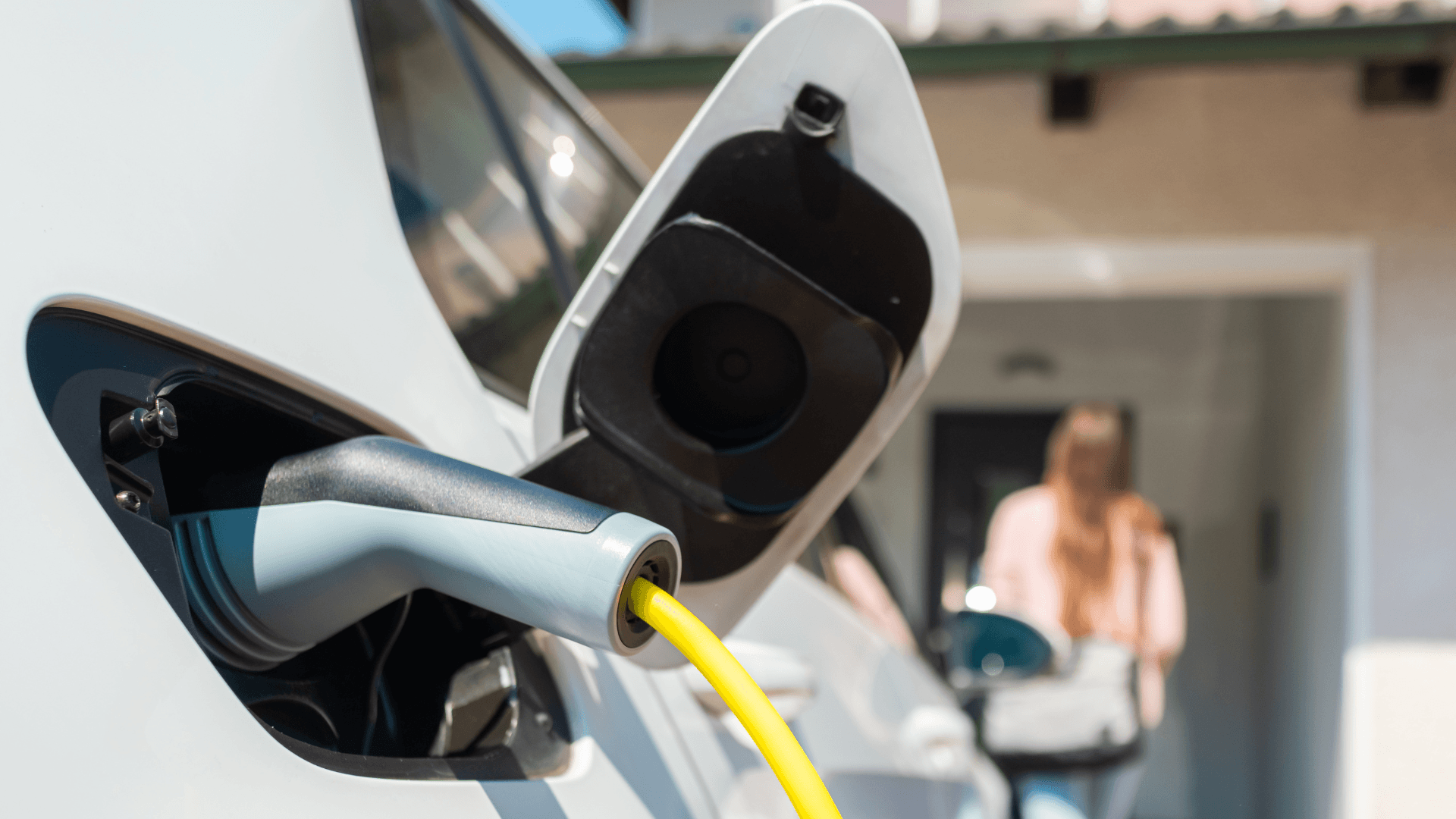
Plug & Play.
From tax credits to transfer switches, here is how to make your home the smartest on the block.
The transition to electric vehicles in South Carolina has moved past early adoption into a phase of serious home infrastructure. For homeowners in Horry County, from the salt air of Myrtle Beach to the historic homes of Conway, a Level 2 charger is no longer just a luxury. However, as a professional energy auditor, I see too many people rushing into installations that ignore the technical reality of their electrical panels. This guide covers the financial deadlines, the engineering shortcuts, and the new standards that the big-box retailers will not tell you.
The Federal 30C Deadline: June 30, 2026
The most urgent piece of news for 2026 is the sunsetting of the Alternative Fuel Refueling Property Credit.
The Benefit: A federal tax credit covering 30% of hardware and installation labor.
The Limit: A maximum credit of $1,000 per residential installation.
The Hard Stop: To qualify, your charger must be fully installed and operational by June 30, 2026.
The Location Filter: This credit is only available in specific census tracts defined as non-urban or low-income. In our region, many addresses in Loris, Longs, and rural Aynor qualify, while high-density coastal zones may not. Verifying your address against the current IRS map is the first step before purchasing equipment.
The NEC 2026 80% Rule: A Loophole for Older Homes
One of the biggest hurdles to EV charging is the dreaded $3,000 panel upgrade. If your home has 100-amp or 150-amp service, a standard 50-amp charger often fails a traditional load calculation.
However, the 2026 National Electrical Code has introduced a more realistic way to calculate demand. Under new provisions for existing dwellings, certain EV charging loads can now be calculated at an 80% demand factor rather than the previous 100% or 125% requirements. This technical shift means many homes that were previously considered maxed out can now safely support a Level 2 charger without replacing the entire service entrance.
Always consult with a licensed and insured electrician before making any changes to any power system.
Skip the Upgrade with Power Control Systems (PCS)
If your panel is truly at its limit, you still have options. Section 120.7 of the 2026 NEC formally recognizes Power Control Systems. These smart devices monitor the total real-time draw of your home. If you turn on your electric oven and clothes dryer simultaneously, the PCS will automatically throttle the EV charger down. Once the heavy appliances finish their cycle, the charger ramps back up to full speed. This allows for high-speed charging on limited panels while ensuring you never trip the main breaker. This technology effectively solves the $3,000 pain point of a panel upgrade by using software to manage hardware limits.
Always consult with a licensed and insured electrician before making any changes to any power system.
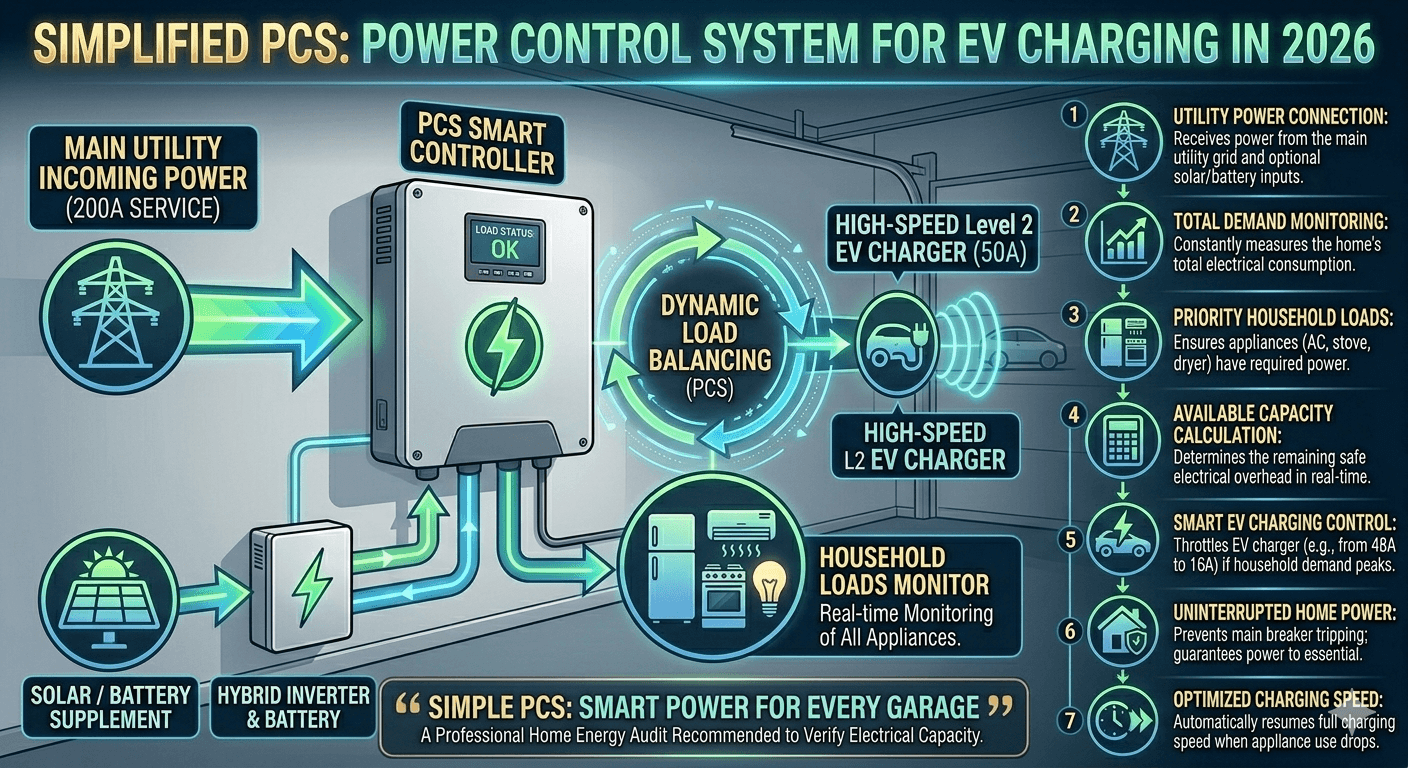
Power Control System for EV Charging
Storm Prep with Bidirectional V2H Technology
In Horry County, hurricane preparedness is a way of life. In 2026, we are seeing a massive surge in interest regarding Vehicle-to-Home (V2H) technology. Many new electric trucks and SUVs now support bidirectional charging, which allows the vehicle to act as a massive home battery.
With the right transfer switch and inverter setup, your vehicle battery can power your refrigerator, well pump, and lights during a coastal power outage. This is a high-value strategy for tech-savvy homeowners who want to avoid the noise and maintenance of a traditional gas generator. As an auditor, I help homeowners determine if their existing electrical setup is compatible with these islanding systems, effectively turning an EV into a silent, zero-emission backup generator for days at a time.
Use the sliders below to see how prioritizing your critical loads (like a refrigerator or well pump) can stretch your survival time from 48 hours to over a week.
Storm Survival Calculator
Horry County 2026: EV (V2H) vs. 10kW Portable Generator
*V2H calculation assumes 20% emergency driving reserve. Generator runtime based on 20-gallon fuel limit at 50% load consumption (~11 gal/day).
The Multi-Charger Challenge
As more households in South Carolina become two-EV families, the demand on the garage electrical circuit doubles. Rather than running two separate 50-amp lines—which few residential panels can support—the 2026 solution is Circuit Sharing or Group Load Management.
Smart chargers can now communicate with each other to split a single 50-amp circuit. If one car is plugged in, it gets the full 40 amps of delivery. If a second car is plugged in, the chargers negotiate to provide 20 amps to each. This ensures both vehicles are topped off by morning without exceeding the safety limits of your home wiring. This is the essential fix for the growing second-car market that wants to avoid massive rewiring projects.
Coastal Maintenance: Salt, Sand, and Software
For homes within five miles of the Atlantic, standard maintenance is a requirement for longevity. Salt air is highly corrosive to the copper contacts inside an EV connector. In 2026, we recommend a quarterly inspection of the charging pins for any signs of green oxidation or pitting. Using a specialized electronic contact cleaner can prevent the high-resistance connections that lead to charger overheating and failure. Furthermore, ensure your charger's firmware is updated. Modern smart chargers receive monthly software patches to improve compatibility with new vehicle battery management systems and to fix security vulnerabilities in your home network.
Charging as Home Equity
By early 2026, real estate data has confirmed that Level 2 charging infrastructure is no longer a niche upgrade but a standard expectation for modern buyers. Homes listed as EV Ready are seeing faster turnover and higher closing prices across South Carolina. For many families, seeing a high-quality, hardwired charging station in the garage provides the same psychological reassurance as a newly renovated roof or a modern HVAC system. It signals that the home is future-proofed for the next decade of transportation.
The Closed-Loop Energy Strategy
For homeowners with existing solar arrays, 2026 brings the rise of Integrated Home Energy Hubs. Instead of selling your excess solar production back to the grid for minimal credits, new smart chargers can communicate directly with your solar inverter. This allows your car to charge exclusively using the surplus energy captured by your roof. By diverting 100% of your clean energy into your vehicle battery, you eliminate fuel costs entirely and maximize the return on your solar investment.
Home Energy Orchestrator
Real-time Closed-Loop Distribution
System Ready
Click a mode below to visualize the Closed-Loop distribution.
The Premium Frontier: Wireless Charging Pads
In custom luxury builds throughout the Myrtle Beach area, we are beginning to see the deployment of Resonant Wireless Charging and Inductive Charging. These systems involve a pad installed on the garage floor and a receiver on the vehicle, eliminating the need to physically plug in a cable. While these systems carry a higher price tag than standard corded units, they offer a seamless, trip-free experience that appeals to homeowners looking for the ultimate in convenience and aesthetic garage design.
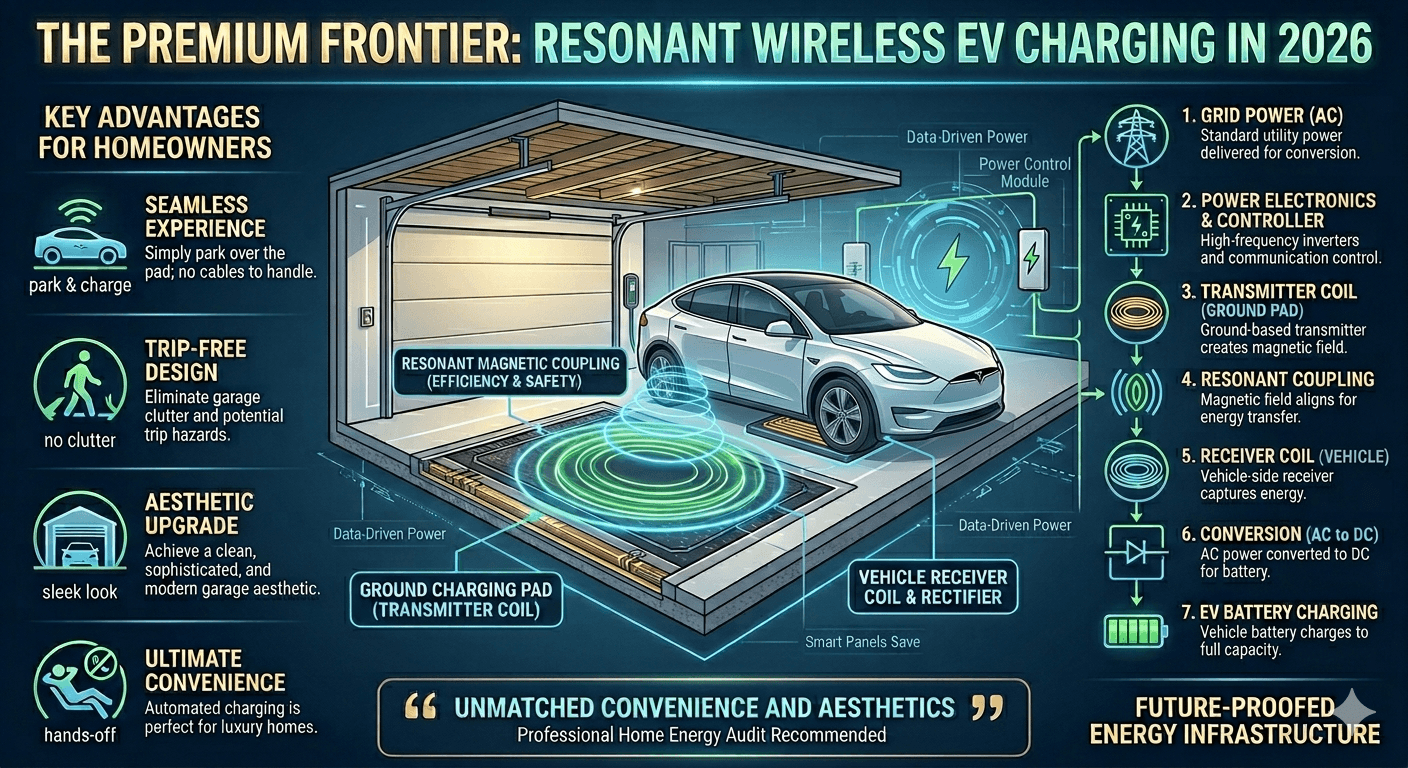
Resonant Wireless EV Charging
Cybersecurity in the Garage: Protecting Your Network
As chargers become more connected, they also become potential gateways to your home network. The 2026 industry standards, specifically the widespread adoption of the OCPP 2.0.1 protocol, focus heavily on digital safety.Professional auditors now look for hardware that supports encrypted communication and secure boot sequences. Ensuring your charger is part of a secure, managed ecosystem prevents it from being a backdoor for cyber-attacks, protecting both your vehicle and your home data.
Maximizing Local South Carolina Utility Credits
Local power providers offer specific programs that stack with federal incentives:
Duke Energy: The EV Prep credit can provide over $1,200 to help cover the cost of a 240V circuit or a panel sub-grade.
Santee Cooper: Their EV Time-of-Use rates are the most effective way to lower your fuel costs. By shifting your charging to the 11:00 PM to 5:00 AM window, the cost per mile becomes significantly lower than the cost of gasoline.
The Auditor’s Final Word: Load Before You Lead
The smartest way to install a charger is to first reduce the energy your home wastes. By improving attic insulation or sealing ductwork, you reduce the peak demand of your HVAC system. This creates electrical headroom, making it easier and safer to add an EV charger. In many cases, an air-sealing and insulation upgrade is the difference between a simple charger install and a massive electrical overhaul.
General Disclaimer: All information is provided for educational purposes and reflects 2026 federal and state guidelines. High-voltage electrical work must be performed by a licensed electrician to ensure compliance with local Horry County building codes. Federal tax credits are subject to individual tax liability and census tract eligibility.