

Considering the Switch to a Heat Pump Water Heater?
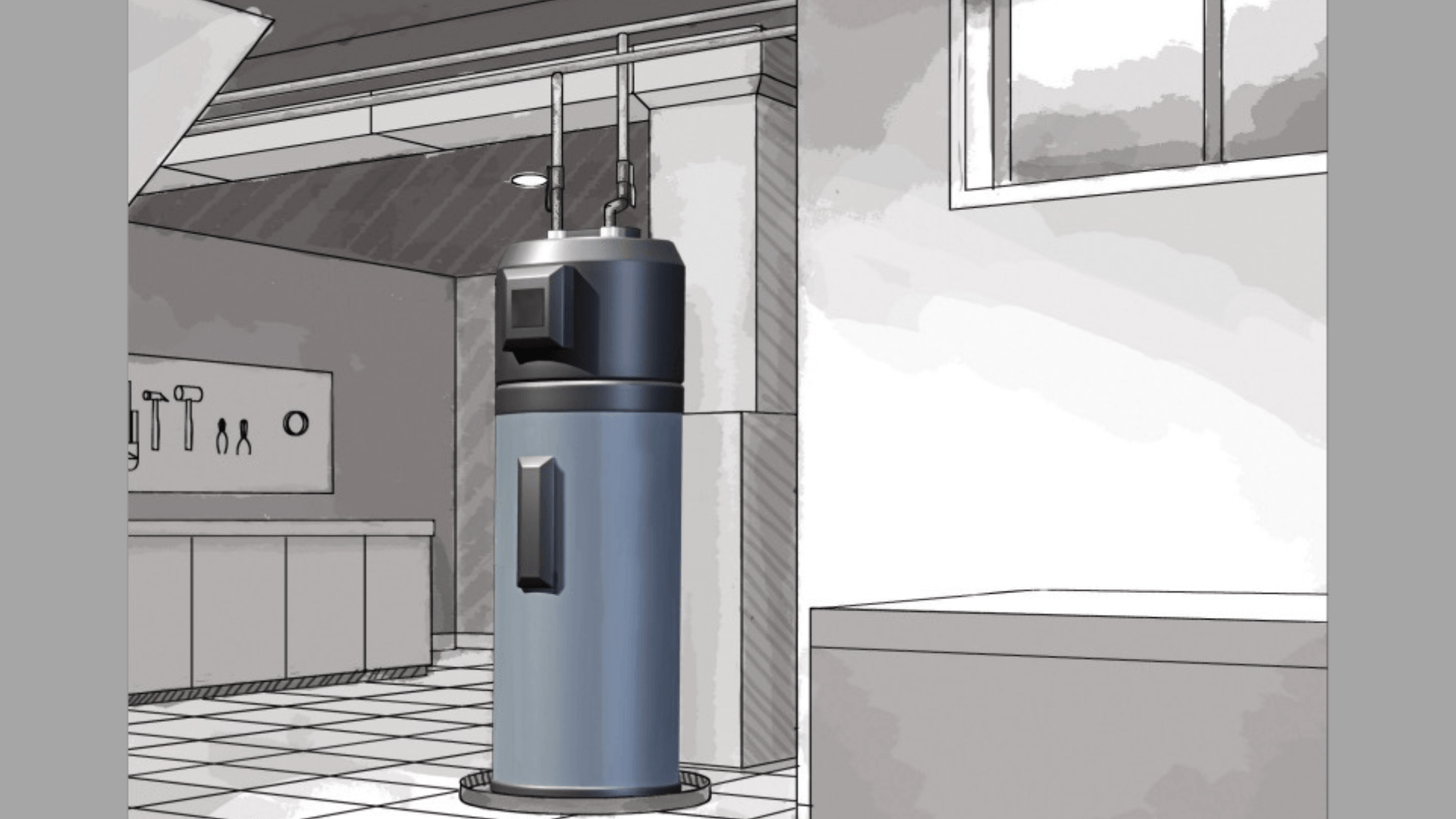
In Hot Water.
Proof that moving heat is significantly cheaper than creating it—and your wallet is the beneficiary.
What is a Heat Pump Water Heater?
While a standard electric water heater works like a giant teakettle—using high-resistance coils to cook the water—a Heat Pump Water Heater (HPWH) works like a refrigerator in reverse. Instead of blowing heat out of a box to keep your milk cold, it pulls heat from the surrounding air and "pumps" it into your water tank.
Because it is moving existing heat rather than creating new heat from raw electricity, it is incredibly efficient. Most units are Hybrid, meaning they still have standard electric elements as a backup for high-demand periods.
The Science: The Vapor-Compression Cycle
The magic happens via a refrigerant loop. Even in a 50°F garage, there is enough thermal energy in the air to heat water to 120°F or higher. Here is the process:
Evaporation: A fan pulls ambient air over an evaporator coil containing a cold liquid refrigerant. The refrigerant absorbs the heat from the air and turns into a gas.
Compression: A compressor squeezes that gas, which causes its temperature to spike significantly.
Heat Exchange: This hot gas passes through a condenser coil wrapped around the water tank, transferring its heat to the water.
Expansion: The refrigerant cools down, passes through an expansion valve to become a cold liquid again, and the cycle repeats.
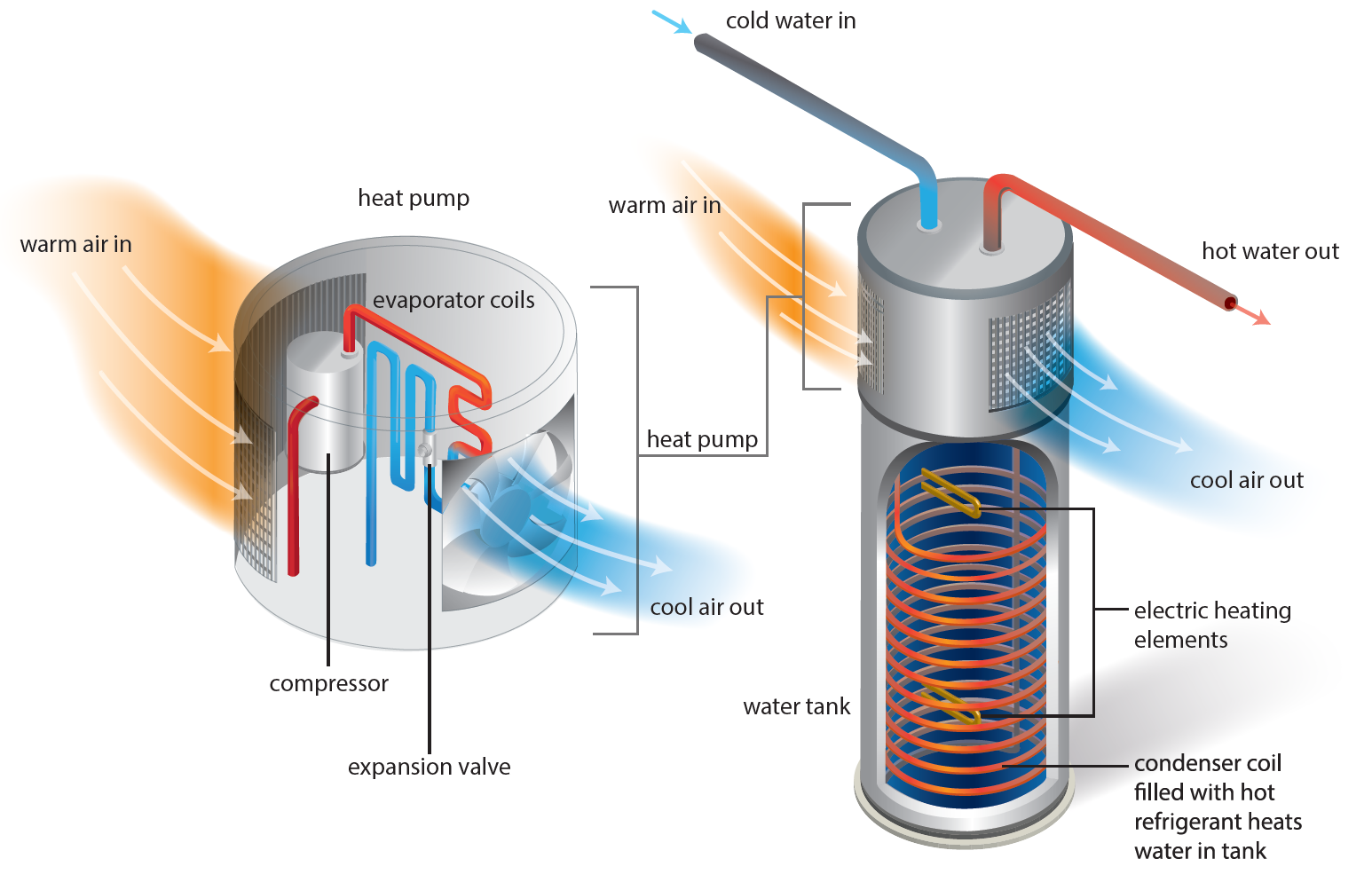
This diagram illustrates the heat pump cycle where warm ambient air is pulled across evaporator coils, concentrated by a compressor, and transferred into the water tank via a condenser coil to provide high-efficiency heating.
Efficiency Metric: COP
The efficiency of these systems is measured by the Coefficient of Performance (COP).
Standard Electric Resistance: COP = 1.0 (1 unit of electricity = 1 unit of heat).
Heat Pump Water Heater: COP ≈ 3.0 to 4.0 (1 unit of electricity = 3 to 4 units of heat).
The Comparison: Standard vs. HPWH
| System Feature | Standard Electric | Heat Pump (Hybrid) |
|---|---|---|
| Energy Source | Electric Resistance Coils | Ambient Air + Electricity |
| Efficiency | ~95% | 300% – 400% |
| Annual Operating Cost | $500 - $800 | $150 - $250 |
| Recovery Speed | Fast | Slower (unless in Hybrid mode) |
| Climate Benefits | None | Cool Air & Dehumidification |
| Service Life | 10–12 Years | 13–15 Years |
The Indoor Bonus: Dehumidification
Because the unit pulls heat and moisture out of the air to function, it acts as a built-in dehumidifier.
Best Locations: Unfinished basements, garages, or large mechanical rooms. It keeps these areas dry, preventing mold and mildew.
The Trade-off: The unit exhausts cool air. In the summer, this is "free" air conditioning. In the winter, if the unit is in a conditioned living space, your furnace has to work slightly harder to make up for that cool air.
Important: HPWHs need space. Most manufacturers require at least 750 to 1,000 cubic feet of air space to operate effectively. If you put one in a tiny closet, it will "suffocate" and switch back to expensive electric resistance mode. The condensate line will need a drain or condensate pump to move the water.
Financials: Savings and Rebates
The upfront cost of an HPWH is higher ($1,500–$3,000 vs. $600 for a standard tank), but the ROI is often the best of any home appliance.
Annual Savings: A typical family of four saves between $300 and $500 per year on their power bill by switching from electric resistance to heat pump technology.
HEAR & HOMES Rebates: While federal tax credits have sunset, the state-administered rebate programs remain the most powerful financial tool. Depending on your income level, these programs can provide up to $1,750 as a point-of-sale rebate.
Utility Rebates: Many local electric cooperatives continue to offer independent mail-in rebates (often $200–$800). Utilities prioritize these because HPWHs significantly reduce the total peak load on the electrical grid.
Other Considerations for Heat Pump Water Heaters
Heat pump water heaters can save almost every household money. Before diving in, consider these real-world factors:
Slower Recharge Time: In "Heat Pump Only" mode, it takes longer to recover a full tank of hot water than a standard heater. HPWH provide plenty of hot water for most homes, but if you have five people showering in a row, the unit will likely switch to Hybrid or Electric mode to keep up, which temporarily lowers your efficiency.
Noise: Unlike silent standard tanks, HPWHs have a fan and a compressor. It sounds roughly like a loud dishwasher. Not usually a problem if it’s in a garage, but if it’s indoors you may want to consider sound dampening wall panels. If your HPWH is placed indoors, you may be able to feel vibrations through the floor when it kicks on. This can easily be remedied by installation a vibration isolation pad, a simple $30 fix.
Annual Maintenance is Mandatory: To keep most 10-year manufacturer warranties, you must:
Clean the air filter every few months.
Check the condensate drain to ensure it isn't clogged.
Flush the tank annually to prevent sediment buildup.
Some warranties require proof of annual maintenance by a licensed professional.
Vertical Space: These units are often taller than standard tanks because the heat pump hardware sits on top of the tank. Ensure your ceiling height can accommodate it!
Conclusion
The Bottom Line on Efficiency
Switching to a heat pump water heater is one of the most impactful upgrades you can make for your home’s energy profile. While the transition from federal tax credits to state-level rebates has changed the financial landscape, the core math remains the same: moving heat is fundamentally cheaper than creating it. By accounting for space requirements, managing your recovery modes, and committing to professional annual maintenance, you can secure a decade of lower utility bills and reliable performance. It isn’t just about changing an appliance; it’s about upgrading to a smarter, more resilient way of powering your daily life.
Ready to Upgrade?
Navigating the technical requirements and rebate eligibility for a new heat pump water heater can be a headache. Rappid Energy is here to simplify the process. From site suitability assessments to maximizing your state incentive savings, we provide the expert consulting you need to get the job done right.
Disclaimer: The information provided in this article is for educational purposes only. Rebate eligibility and funding for state-administered programs like HEAR and HOMES vary by location and household income; please verify current availability with your local utility or state energy office. Heat pump water heaters require specialized installation and professional annual maintenance to ensure safety and maintain manufacturer warranties. Rappid Energy assumes no liability for results or financial outcomes based on the use of this guide. Always consult a licensed professional to determine the technical suitability of this equipment for your specific home environment.