

The Silent Killer: An In-Depth Guide to Carbon Monoxide and Home Safety
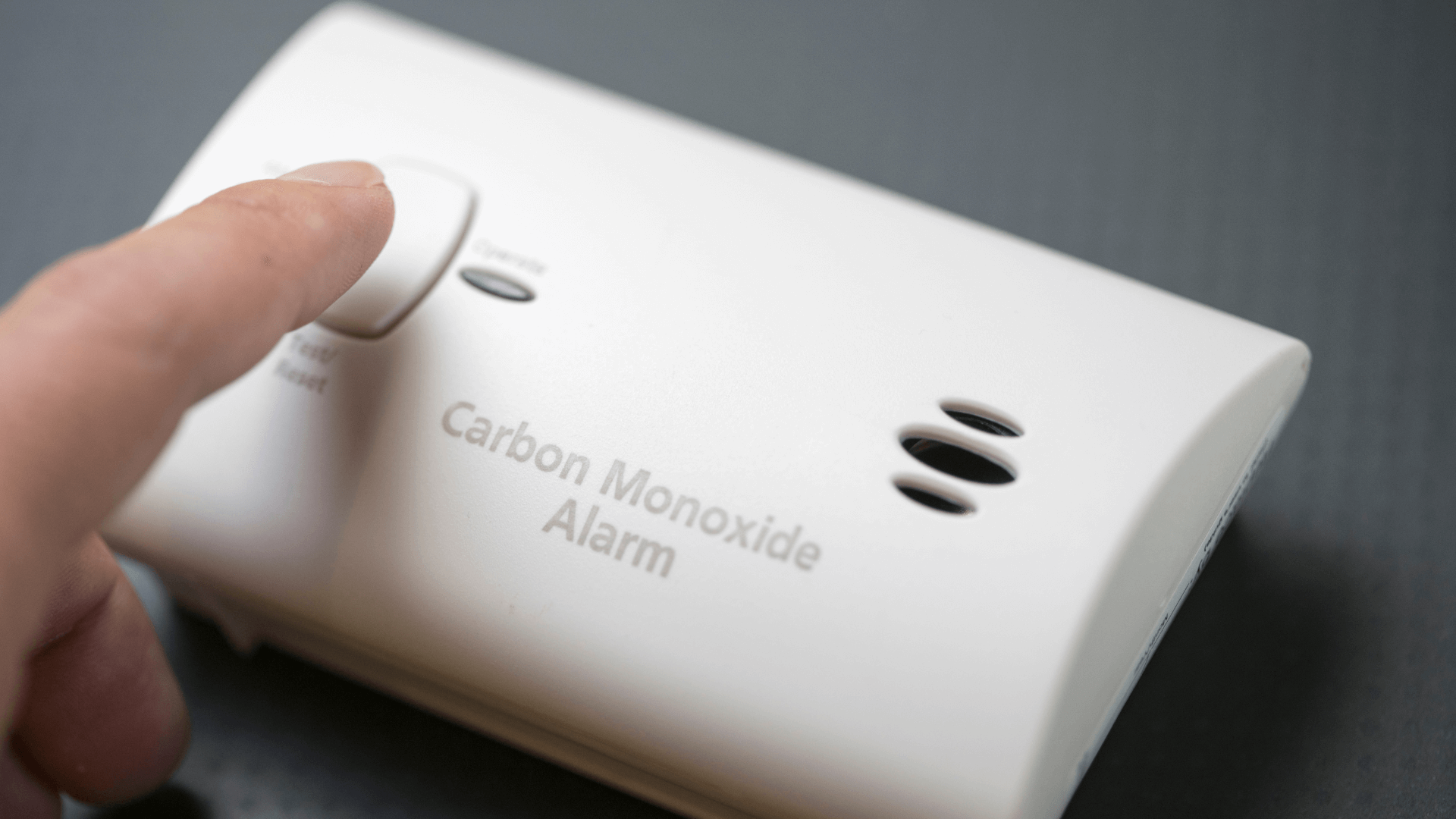
Don’t wait for the tone.
Beeps aren't early warnings; they are signals that you’ve already been breathing CO for hours.
Carbon Monoxide (CO) is one of the most misunderstood threats in the modern home. It is a colorless, odorless, and tasteless gas produced by the incomplete combustion of fuels such as natural gas, propane, heating oil, wood, and charcoal. In the era of high-performance, airtight homes, CO is no longer just a maintenance issue; it is a pressure and physics issue.
What is Carbon Monoxide?
Carbon monoxide is produced whenever a carbon-based fuel burns without enough oxygen to create CO2. Instead, it creates CO.
When you inhale CO, it enters your bloodstream and binds to your hemoglobin—the part of your blood that carries oxygen—to form Carboxyhemoglobin (COHb). Carbon Monoxide binds to your blood 200 times more strongly than oxygen does. Essentially, CO locks the door so oxygen can't get in. You aren't just breathing a toxin; you are suffocating at a cellular level, even if the room is full of air.
The "Heavier Than Air" Myth
One of the most dangerous myths is that CO is "heavy" and sinks to the floor. In reality, Carbon Monoxide is very slightly lighter than air. It doesn’t pool on the ground; it mixes evenly throughout the room and often hitches a ride on warm, rising air currents from your furnace or water heater. This is why placement of detectors is so critical.
The Flu-Like Symptoms: Identifying Chronic Poisoning
CO is known as the "Great Imitator" because its symptoms feel exactly like the winter flu. If everyone in your house—including pets—feels better as soon as they leave the building, you likely have a CO issue.
Dull Headache (The most common early sign)
Dizziness and Nausea
Breathlessness during mild exertion
Confusion or "Brain Fog"
The Pressure Trap: How Efficiency Can Cause Backdrafting
In an old, leaky house, a water heater’s exhaust naturally rises up the chimney because the house is full of "make-up air" leaking through the walls. When we seal those leaks to save energy, the house becomes a sealed vessel.
If you turn on a powerful 1,200 CFM range hood or a large clothes dryer, the house becomes depressurized. Because air must come from somewhere, the house may actually pull air down your furnace or water heater chimney to equalize pressure. This is called backdrafting, and it dumps 100% of the combustion exhaust directly into your home.
The "Orphaned" Water Heater: A Common Safety Failure
One of the most dangerous situations we find during a home performance audit is the "Orphaned Water Heater." This occurs when a homeowner replaces an old, mid-efficiency furnace with a new, high-efficiency sealed-combustion unit, but leaves the original gas water heater behind.
The Science of the Failure: Originally, the large furnace and the small water heater shared a chimney (flue). The heat from the large furnace kept the chimney warm, creating a strong "draft" that pulled the water heater's exhaust up and out.
When the new furnace is installed, it vents through its own plastic pipe out the side of the house. Now, the small water heater is left alone to vent into a massive, cold masonry or metal chimney. Because the water heater doesn't produce enough heat to prime that large chimney, the exhaust gases cool down, lose their buoyancy, and spill back into the home.
This creates a persistent, low-level Carbon Monoxide leak that often goes undetected because it only happens when the water heater is running alone.
CO Detectors: The Store-Brand Myth vs. Low-Level Monitors
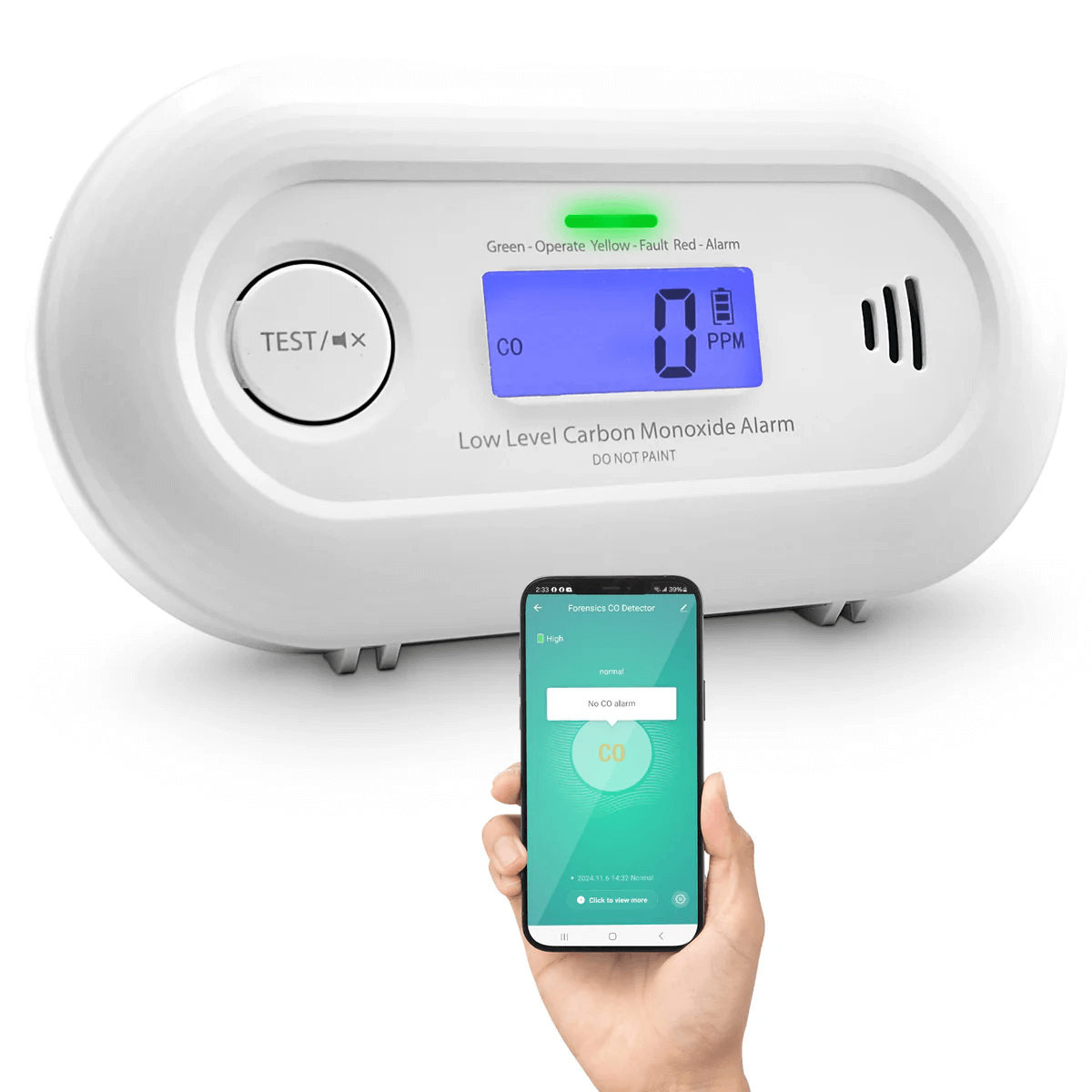
There is a massive, life-saving difference between the $40 alarms available at big-box stores and professional low-level monitors like the Defender brand and Forensics Detectors brand.
The UL 2034 "Standard" (Retail Alarms)
Retail alarms are built to the UL 2034 standard. This standard was designed specifically to prevent "nuisance calls" to utilities and first responders. Because of this, UL-listed alarms are programmed to ignore low levels of CO.
The "Blind Spot": A UL-listed alarm is legally prohibited from sounding at anything below 30 PPM.
The Time Delay: At 70 PPM, a standard alarm will wait up to 4 hours before it makes a sound.
The Risk: For a pregnant woman, a small child, or someone with heart disease, 4 hours of exposure to 70 PPM is not "safety"—it is a medical crisis in progress. Even at 400 PPM, the typical time to alarm is 4-15 minutes.
The Pro-Grade Difference (Low-Level Monitoring)
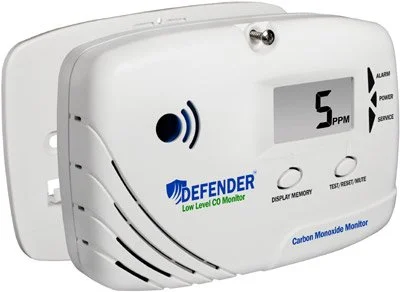
Professional-grade monitors, like the Defender LL6270, use high-accuracy electrochemical sensors that aren't hampered by the UL 2034 "delay" requirements.
Real-Time Data: While the retail alarm stays silent, a Defender will show you 5 PPM the moment it’s detected.
Immediate Alerts: These units often beep at 15 PPM after 60 minutes—a level that a retail alarm would ignore for weeks.
Sensor Quality: Pro monitors use water-based electrolytes that don't dry out as quickly as cheap retail sensors, providing a much more stable baseline for safety.
Professional Action Levels & The 70 PPM Threshold
In the professional home performance industry, we don't guess about safety. We use calibrated equipment to monitor the chemistry of the air. If the numbers hit specific thresholds, the professional protocol is non-negotiable.
0 – 9 PPM: Acceptable. No immediate action, but we investigate the source.
10 – 35 PPM: Caution. Advise the occupant, open windows, and hunt for the leak.
36 – 69 PPM: Intervention. Turn off all combustion sources immediately and call a specialist.
70+ PPM: EVACUATE. At this level, the home is considered hazardous. The inspection is terminated immediately. Everyone must leave the building, and 911 should be called from outside.
| CO Level (PPM) | BPI Safety Protocol (Analyst) | UL 2034 Alarm Response (Retail) |
|---|---|---|
| 0 – 9 PPM | NormalProceed with audit; identify CO source. | SILENT. Legal standard prohibits alarms at this level. |
| 10 – 35 PPM | CautionNotify occupant, open windows, hunt for leak. | SILENT. Retail units will ignore this level indefinitely. |
| 36 – 69 PPM | InterventionDisable failing appliances; call specialist. | SILENT. Alarms will not sound for hours. |
| 70 PPM | EVACUATE IMMEDIATELY Stop work, exit building, call 911. | UP TO 4 HOUR DELAY. Under UL 2034, alarms can stay silent for 240 minutes. |
| 400+ PPM | Lethal Hazard Immediate life-safety crisis. | 4 - 15 MINUTES. Mandatory alarm response time. |
The Industry Compromise: Why "Legal" Isn't "Safe"
The most egregious part of the UL 2034 standard is that it intentionally builds in a massive window of exposure. While a professional sees 70 PPM as a reason to clear a building immediately, the retail industry and regulatory bodies see it as a "nuisance level" that doesn't require an immediate siren.
A Coordinated Effort to Reduce Liability
The UL (Underwriters Laboratories) standard wasn't created in a vacuum. It was heavily influenced by a coalition of utility companies, gas providers, and first responders.
The Cost of False Alarms: Before these standards were tightened, emergency crews and gas company technicians were overwhelmed by calls triggered by minor, transient spikes—such as a car idling briefly near a window or a puff of backdraft from a heavy gust of wind.
The Solution: Rather than requiring more sophisticated (and expensive) sensors that could differentiate between a transient spike and a persistent leak, the industry opted to program retail alarms to ignore the gas until it reaches an undeniable, life-threatening concentration over time.
The Toxicology vs. The Standard
When you sit in a room with 70 PPM for four hours waiting for a retail alarm to sound, your body is actively absorbing that gas. By the time the alarm finally chirps:
Your Carboxyhemoglobin (COHb) levels can reach 10% or higher.
Your heart is under significant strain, working harder to move oxygen to your brain.
The "safety" device has allowed you to reach a level of blood saturation that can lead to long-term neurological symptoms.
The Buyer’s Guide: High-Performance vs. Retail
If you are standing in a hardware store aisle, every box looks the same. They all have pictures of happy families and "10-Year Battery" stickers. But for those of us who measure home performance for a living, the only thing that matters is the sensor logic.
1. Look for "Low-Level" or "Health" Monitors
Standard retail alarms will say "UL 2034 Listed." While this means they won't blow up or fail to beep eventually, it also confirms they have the built-in 4-hour delay at 70 PPM.
The Expert Choice: Look for monitors that explicitly state they provide Low-Level CO Monitoring. These are often listed as UL 2034 and UL 2075, or they may bypass the UL 2034 "delay" requirement by being marketed as a "monitor" rather than an "alarm."
2. The Digital Display is Non-Negotiable
Cheap alarms often have no screen—only a "Power" light and an "Alarm" light. This is useless for monitoring and reading CO levels.
Why it matters: You want a monitor that shows you Real-Time PPM. If your water heater is starting to fail, a professional monitor will show you a "20" or "30" on the screen. You can call a technician and fix the problem for $200 before it becomes a $5,000 emergency or a trip to the hospital.
3. Sensor Life and "End of Life" Warnings
Because the electrochemical sensors are essentially a liquid-state battery, they have a "Use By" date.
Pro Tip: High-quality units use a more stable electrolyte and are rated for 6-10 years. Avoid "no-name" brands from online marketplaces that don't clearly state the sensor's lifespan.
Where to Place Your Detectors
Since CO travels with air currents and mixes evenly, placement is everything.
Height: 5 feet high or on the ceiling. Knee-height is too low.
Near Bedrooms: Must be loud enough to wake you up.
Every Floor: Includes finished attics and basements.
Near the Garage: Place one in the room adjacent to the garage door (usually a hallway, laundry room, or kitchen) to catch "Stack Effect" leaks from idling cars.
Note that a CO detector is different than a combustible gas leak detector. Combustible Gas Leak Detectors should be placed low on the wall for propane (sinks) and high on the wall for natural gas (floats). Always follow manufacturers instructions when placing your CO detector or Combustible Gas Leak Detector.
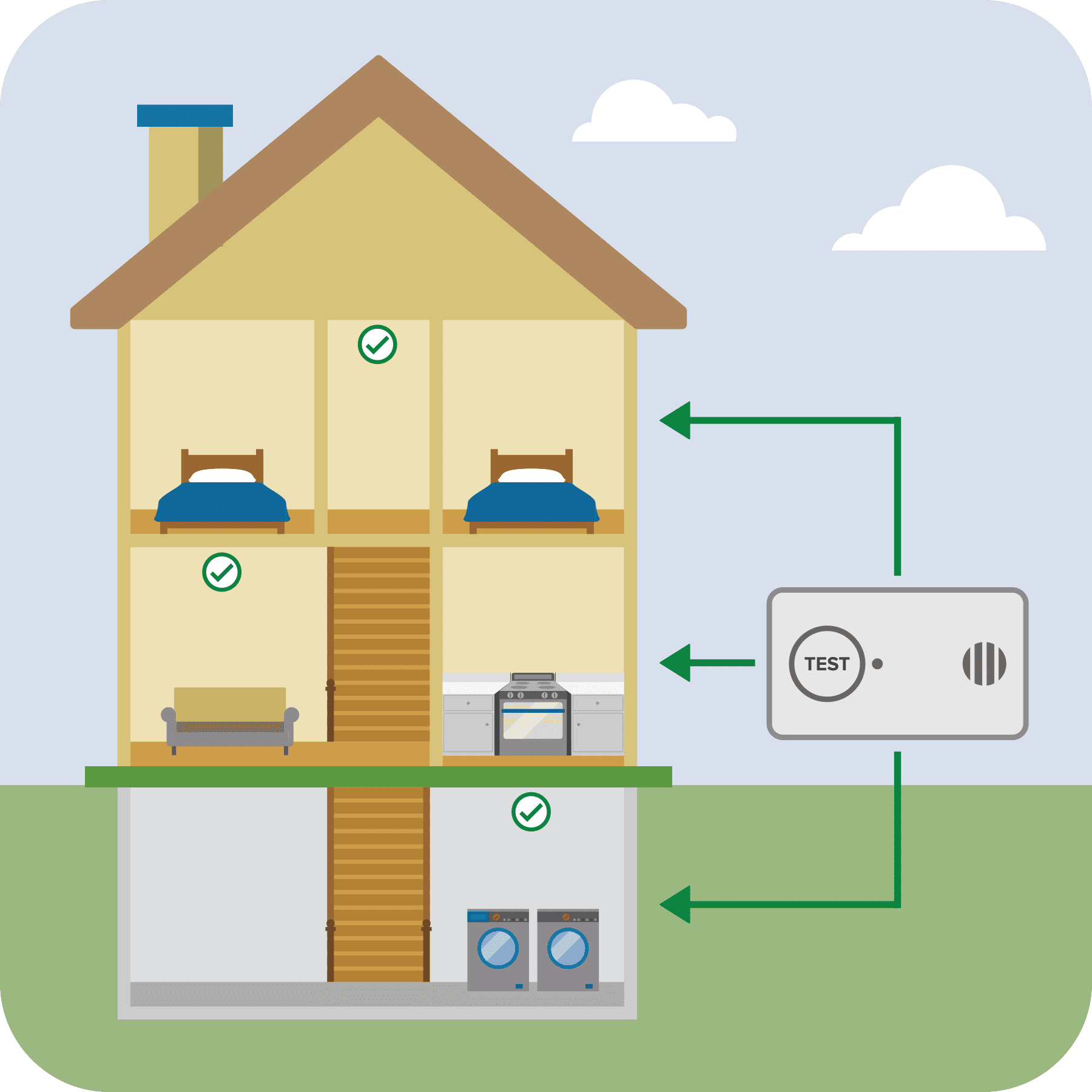
Place CO Detectors on every level of the home: basement, living space, room adjacent to garage, and upstairs hallway between bedrooms.
Why Sensors "Die"
Even a high-end monitor has a shelf life. Electrochemical sensors work by a chemical reaction—like a battery.
Electrolyte Dehydration: In dry winters or humid summers, the chemical "soup" inside the sensor degrades.
Sensor Poisoning: Common household chemicals (silicones, bleach, perfumes) can "coat" the sensor, making it blind to CO.
End of Life: Most modern detectors will chirp at the 5 to 7-year mark. Do not ignore this. The sensor is chemically exhausted. Professional Grade CO Detectors generally last 7-10 years—this information is available on the manufacturers websites.
Summary: The Combustion Safety Test
A homeowner can buy a detector, but they cannot perform a Combustion Appliance Zone (CAZ) Test. During a professional audit, we perform "Worst-Case Depressurization." We turn on every exhaust fan in the house to see if we can force the appliances to fail. If they spill exhaust during this test, your family is at risk every time you do laundry while cooking dinner. Contact us at Rappid Energy for a Home Energy Audit today.